








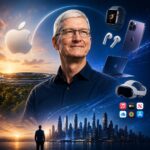
Apple CEO Transition 2026: John Ternus To Lead Apple As Tim Cook Becomes Executive Chairman
Apple’s leadership transition from Tim Cook to become Executive Chairman, John Ternus Named next Apple CEO.

The announcement of a leadership transition at Apple is not merely a corporate restructuring story — it is a defining moment for the global technology industry. After shaping Apple for over a decade as Chief Executive Officer, Tim Cook will move into the role of Executive Chairman, while longtime Apple executive John Ternus is set to become the company’s next CEO from September 1, 2026.
The move marks the beginning of a new chapter for the world’s most valuable technology company at a time when artificial intelligence, mixed reality, semiconductor innovation, and digital ecosystems are rapidly transforming the global tech landscape.
Unlike abrupt executive exits often seen in Silicon Valley, Apple’s succession plan reflects continuity, institutional stability, and long-term strategic preparation. The company stated that the transition follows an extensive succession planning process approved unanimously by Apple’s board of directors.
According to information released by Apple, Tim Cook will continue serving as CEO through the summer before formally assuming the role of Executive Chairman, where he will continue supporting the company in strategic and policy-related areas.
Reflecting on his journey at Apple, Cook said, “It has been the greatest privilege of my life to be the CEO of Apple and to have been trusted to lead such an extraordinary company.” He added that he remains deeply grateful to Apple’s teams for their “unwavering dedication to enriching the lives of customers and creating the best products and services in the world.”
Cook’s leadership era transformed Apple from a premium hardware company into one of the most influential digital ecosystems in the world. When he took charge in 2011 following the passing of Steve Jobs, many questioned whether anyone could sustain Apple’s momentum after Jobs. More than a decade later, Cook’s tenure has proven historically significant.
Under his leadership, Apple expanded far beyond the iPhone. The company built powerful new business verticals through products like the Apple Watch, AirPods, and Apple Vision Pro while simultaneously strengthening its global services ecosystem.
Services including Apple Music, Apple TV+, iCloud, and Apple Pay evolved into major revenue drivers, reducing Apple’s dependence on hardware sales alone. At the same time, Apple’s transition toward custom-designed silicon chips reshaped the company’s engineering capabilities and gave it greater control over performance, efficiency, and ecosystem integration.
Beyond business growth, Cook also positioned Apple around values increasingly important in the digital age — privacy, sustainability, accessibility, and responsible innovation. In a technology industry often criticised for aggressive data collection and weak user protections, Apple consistently differentiated itself through a privacy-first narrative.
Speaking about his successor, Cook said John Ternus has “the mind of an engineer, the soul of an innovator, and the heart to lead with integrity and with honour.” He further stated that Ternus is “a visionary whose contributions to Apple over 25 years are already too numerous to count.”
The rise of John Ternus signals that Apple intends to maintain strong engineering leadership during a period of intense technological disruption.
Ternus joined Apple’s product design team in 2001 and has played a major role in the development of several of Apple’s most important product categories. Over the years, he has overseen hardware engineering efforts across the iPhone, iPad, Mac, AirPods, and Apple Watch ecosystems.
His elevation suggests Apple sees product engineering, hardware reliability, and deep ecosystem integration as central to its future strategy.
The appointment comes at a particularly important time for the technology industry. Artificial intelligence is rapidly becoming the defining competitive battleground among global technology giants. Companies are racing to integrate AI into devices, cloud services, productivity tools, and consumer experiences.
Apple faces growing expectations to strengthen its position in AI-driven computing while preserving its hallmark focus on privacy, design simplicity, and seamless user experience. Ternus’s engineering background could play a critical role in balancing those priorities.
Responding to the announcement, Ternus said, “I am profoundly grateful for this opportunity to carry Apple’s mission forward.” He also reflected on his long journey at Apple, saying he had been fortunate to work under Steve Jobs and to have Tim Cook as his mentor.
“I am humbled to step into this role, and I promise to lead with the values and vision that have come to define this special place for half a century,” Ternus stated.
The transition also reflects Apple’s institutional maturity. Few companies in the technology sector manage leadership succession with such stability and long-term planning. By retaining Cook in an influential Executive Chairman role while promoting an experienced internal leader, Apple appears focused on maintaining continuity during a rapidly evolving global technology cycle.
Apple board chairman Arthur Levinson praised Cook’s legacy, stating that his “unprecedented and outstanding leadership has transformed Apple into the world’s best company.” He added that Apple’s board believes Ternus is “the best possible leader” to guide the company into the future.
Another key aspect of the transition is sustainability and product longevity. Both Cook and Ternus have been associated with Apple’s environmental initiatives, including reducing carbon emissions, increasing recycled material usage, improving repairability, and extending product life cycles. These priorities are becoming increasingly important as global environmental regulations tighten and consumers demand more sustainable technology products.
For India and other emerging technology markets, Apple’s leadership transition carries additional significance. Apple has expanded aggressively in India through manufacturing partnerships, retail expansion, app ecosystem growth, and supply-chain diversification. Future leadership decisions under Ternus could influence Apple’s long-term investment strategy across Asia and other high-growth digital economies.
The leadership shift therefore represents more than a routine executive change. It reflects how Apple is preparing for the next era of global technology competition — one shaped by artificial intelligence, immersive computing, advanced hardware engineering, sustainability, and evolving digital consumer behaviour.
If Tim Cook’s era was defined by scaling Apple into a globally integrated digital ecosystem, John Ternus may now lead the company into an age where intelligence, hardware, and human-centric computing become more deeply interconnected than ever before.








No Comment! Be the first one.