







End of an Era: What Tim Cook’s Exit Means for Apple’s Next Chapter
Tim Cook steps down, leaving behind a legacy of scale, stability, and ecosystem expansion.

When Tim Cook steps down as CEO of Apple Inc. this September, it will mark more than a leadership transition—it will close one of the most consequential chapters in modern corporate history.
Cook did not inherit a struggling company. He inherited a phenomenon shaped by Steve Jobs. Yet the real test was never about preservation; it was about evolution. Over 15 years, Cook redefined what scale, stability, and strategic discipline could look like in a technology company operating under constant global scrutiny.
From Vision to Value
Under Cook, Apple’s transformation was less about spectacle and more about systems. The company’s valuation multiplied dramatically, crossing successive trillion-dollar milestones with remarkable consistency. This was not accidental—it was the result of operational precision, supply chain mastery, and a measured expansion strategy that prioritised sustainability over volatility.
Cook’s background in operations proved decisive. At a time when global supply chains faced unprecedented disruptions—from pandemics to geopolitical tensions—Apple not only endured but expanded. Its deeper integration into markets like China and the steady growth of its global retail footprint reflected a leader focused on long-term positioning rather than short-term optics.
Beyond the iPhone: Building an Ecosystem
If Jobs defined categories, Cook scaled ecosystems. Apple moved beyond being a device-centric company to building an interconnected portfolio of products and services.
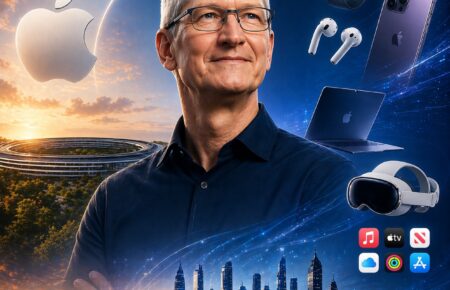
Devices like the Apple Watch and AirPods did more than diversify revenue—they strengthened user lock-in. Meanwhile, services such as Apple Music and Apple TV+ turned Apple into a recurring revenue powerhouse, fundamentally altering its business model.
This shift towards services was perhaps Cook’s most strategic pivot. It reduced dependence on hardware cycles and created a more predictable, subscription-driven revenue stream—one that now forms a significant share of the company’s earnings.
Engineering Independence
Another defining move was Apple’s transition away from Intel processors to its own silicon. This was not merely a technical upgrade; it was a declaration of independence. By controlling both hardware and software at a deeper level, Apple strengthened its competitive moat and reasserted its design philosophy—tight integration, performance efficiency, and user-centric engineering.
The Innovation Debate
Yet, Cook’s tenure has not been without criticism. For some, Apple’s innovation under his leadership appeared incremental rather than disruptive. Products like the Apple Vision Pro, while ambitious, struggled to achieve mass-market traction.
More notably, Apple’s relatively cautious entry into the generative AI race—sparked globally by platforms like ChatGPT—has raised questions about whether the company risks lagging in the next major technological shift. Its push into AI, branded as Apple Intelligence, signals intent, but the pace and impact remain under scrutiny.
A Different Kind of Leadership
Cook’s leadership style stood in contrast to his predecessor. Where Jobs was intuitive and product-obsessed, Cook was methodical and execution-driven. He elevated Apple’s commitments to privacy, sustainability, and ethical supply chains, embedding corporate responsibility into its strategic narrative.
The creation of Apple Park—a campus powered by renewable energy and designed for long-term sustainability—symbolised this broader vision: a company not just building products, but shaping its identity in a changing world.
The Road Ahead
As John Ternus prepares to take over, the challenge is clear but complex. Apple must now navigate an era defined by artificial intelligence, regulatory pressures, and shifting consumer expectations—without losing the operational discipline that defined Cook’s success.
The next phase will demand a balance between bold innovation and the steady execution that has become Apple’s hallmark.
Legacy Beyond Numbers
Tim Cook’s legacy cannot be measured by valuation alone, though the numbers are staggering. His real achievement lies in proving that a company built on visionary disruption can also thrive on operational excellence.
He did not try to replicate Steve Jobs. Instead, he redefined what leadership at Apple could look like—and in doing so, ensured that the company remained not just relevant, but dominant, in an increasingly complex world.
As Apple turns the page, it does so on foundations that are stronger, broader, and more resilient than ever. The question now is not whether Apple can endure—but whether it can once again reinvent the future.
Announcement
Tim Cook announced his retirement through his X handle. He posted, “I want to thank everyone for the outpouring of love and thank you for believing in me to lead the company that has always put you at the center of our work. This is not goodbye. It’s a hello to John and I can’t wait for you to get to know him like I do!”








No Comment! Be the first one.